The Highmark Mann Center for the Performing Arts is celebrating its 50th anniversary this month, marking the celebration with a special performance on June 18 and the completion of a $70 million makeover featuring a new welcome center and plaza.
The Mann has established a reputation as a world-class entertainment venue, right inside Fairmount Park. But the outdoor concert space’s full history goes back over 100 years to its predecessor, the Dell Music Center.
Local historian and archivist Jack McCarthy collected this story in a new book, “A Century of Music Under the Stars: A History of the Mann Center for the Performing Arts and Robin Hood Dell.”
He describes the Philadelphia Orchestra’s prominence in the 1920s, known to the world but out of reach to many Philadelphians. “There was this feeling that we have this phenomenal orchestra, but only a fraction of the local population gets to hear it — the people that can afford tickets in the Academy of Music, their regular season home,” McCarthy said. “There was this general belief in the cultural community, like, we have to make this orchestra more accessible to the people.”
Plus, after its regular concert season concluded in the spring, musicians were essentially out of work until the fall. So The Dell opened in July 1930 in East Fairmount Park as the orchestra’s summer home, narrowly avoiding the impacts of the Great Depression.
But in 1948, the Dell had its lowest-attended season yet due to bad weather and the fact that the Republican National Convention was in town. The venue ended the season three weeks early when money ran out. Help then arrived in the form of Frederic R. Mann, a patron for the arts who made his fortune founding a cardboard box company. He agreed to help the Dell’s board with their troubles if he was granted full control of the institution.
“His strategy was to present the greatest music to the greatest number of people for the most affordable cost,” McCarthy said. “And so he began to present some free concerts and then, in 1952, he announced that the entire season would now be free. This is unheard of.”
Mann’s connections, innovative ideas, and wealth sustained the Dell for several more years. But as time went on, the venue’s golden era waned. Poor weather and the noisy, newly constructed Schuylkill Expressway disrupted performances. It was time to move.
The organization that founded the Dell East — renamed the Dell Music Center in 2010 — transferred management to the city in 1975. Then the Robin Hood Dell West opened across the river in 1976, and was renamed the Mann Center in 1979.
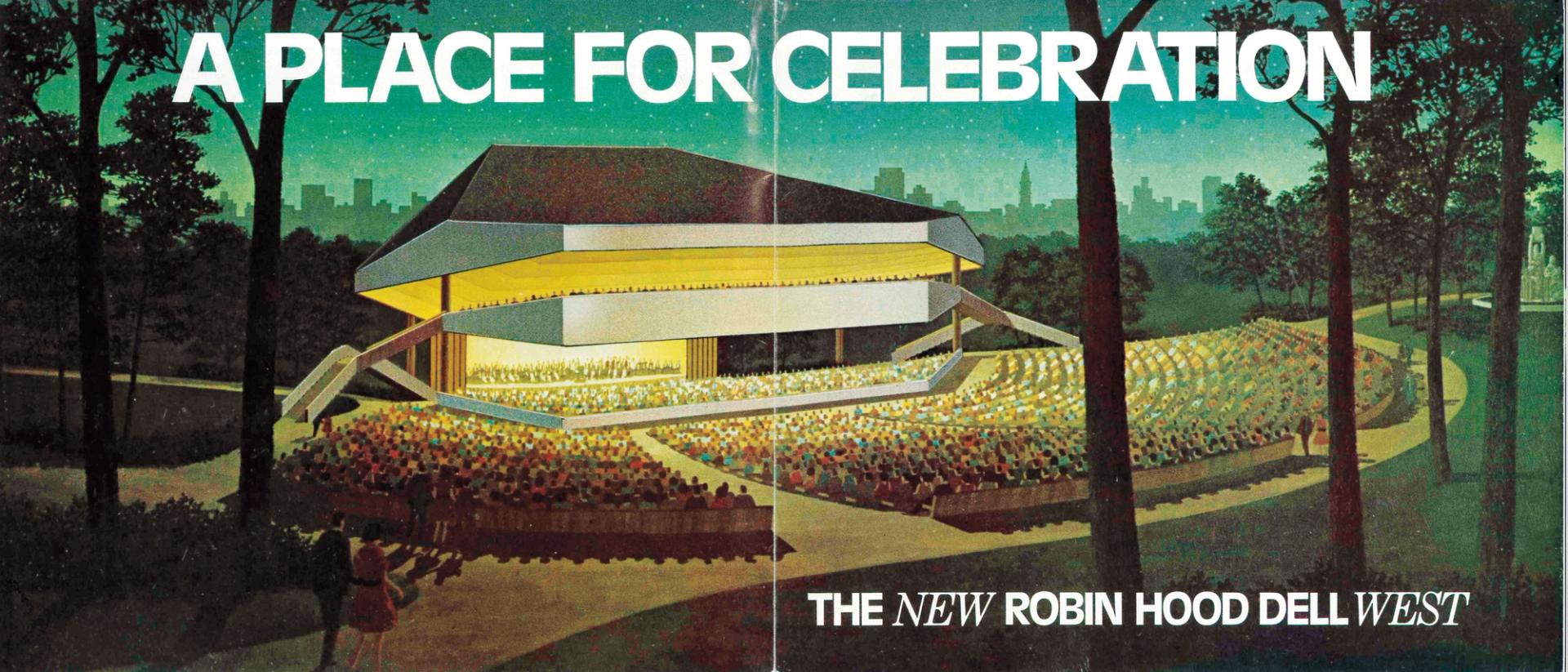
The 1976 promotional brochure for the new Robin Hood Dell West. (Courtesy of the Highmark Mann Center for the Performing Arts Archives)
The opening of the new music center wasn’t without its hurdles. Ideally, a concert venue would have finished construction well before its debut. That wasn’t the case for The Dell West.
“The cement truck drivers went on strike that summer so there was no concrete delivered…things just were way, way behind,” McCarthy said. The seating in the balcony was installed like the day before opening night…The sod had not been laid on the lawn until like two days before. It was just a field of mud.”
The acoustics, the most important part, were the biggest problem.
“They did not have time to test and fine-tune that sound system, so it was a disaster,” McCarthy said. “They were able, over the course of the season, to fine-tune it. Then at the end of the season, they did a major upgrade so that the second season was much better.”
The move marked a shift in audience tastes. Though Mann was a big proponent of classical music, the market for that was shrinking as a new generation of music lovers preferred the genres dominating the airwaves. So Mann invited music promoter and founder of the Electric Factory, Larry Magid, to present a series of rock and pop shows featuring artists such as James Taylor, Barry Manilow, and The Carpenters. Taylor was the first nonclassical artist to perform at the venue.
“Over the course of 30 years, it went from being a classical music venue with some rock and pop to a rock and pop venue with some classical music,” McCarthy said. “The audience for classical music was shrinking, but the cost of presenting the orchestra was rising dramatically, and they weren't getting enough income from those concerts to support that.”
The Mann remains the summer home of the Philadelphia Orchestra and has a plethora of performances across genres. It has connected with the Philadelphia community, especially its Parkside neighbors, through workforce development programs and arts education initiatives. And as a result the Mann has remained an important gathering space for the city.
The full history with archival photos of both music venues and their impact on Philadelphia’s music scene can be read in “A Century of Music Under the Stars: A History of the Mann Center for the Performing Arts and Robin Hood Dell.” The book can be ordered here.